Search / recall
Search is a seed, not a filter.
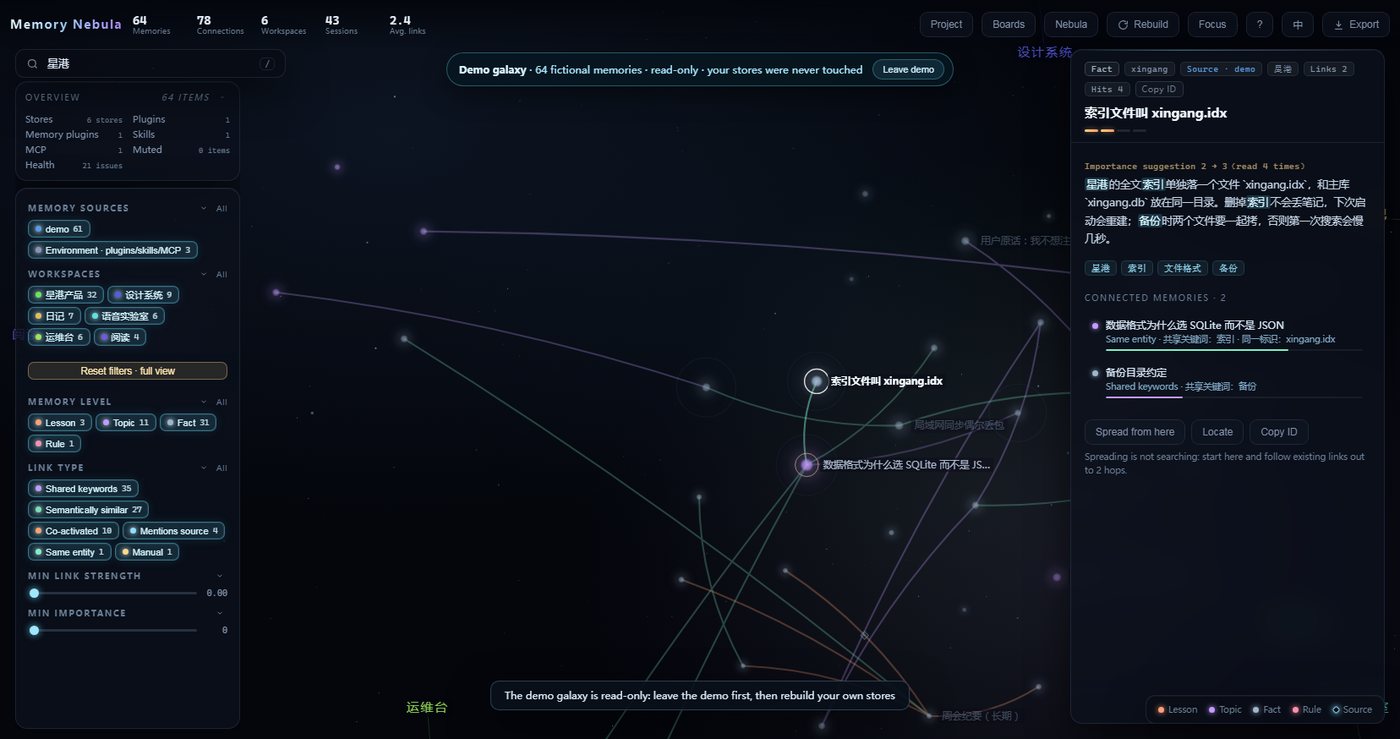
Type one word. The map returns direct hits, then the neighbours they activate, with a budget so a common word cannot flood the page.
A read-only nebula for every store on this machine — meow-memory, OpenViking, notes, SQLite. See what connects, follow the evidence, and hand someone one file instead of your whole life.
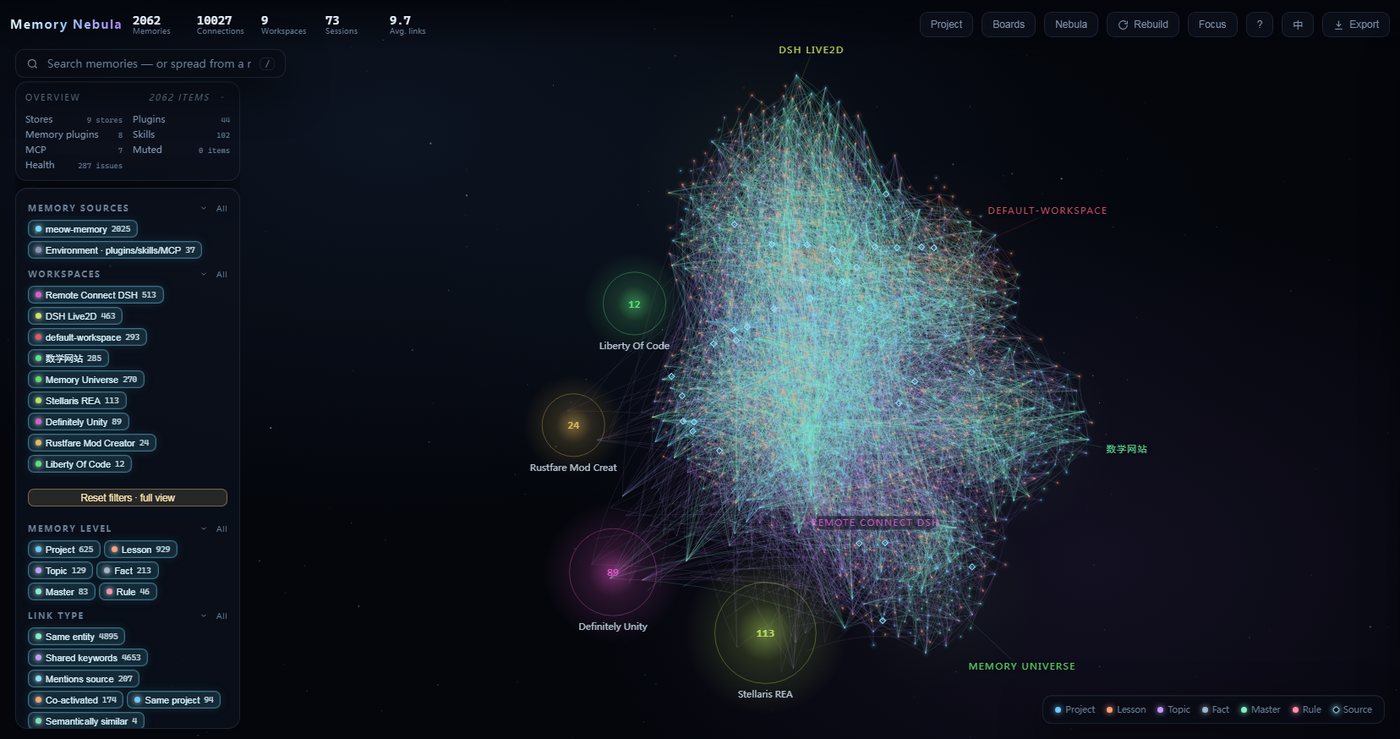
Most memory tools give you a list and a search box. This one gives you the shape: which memories keep appearing together, which project they belong to, and what evidence made the link.
Start from a word, then walk outward along real edges. Every hit carries its path, its workspace, and the reason it surfaced.
Click two blobs and get the shortest chain: shared entity, same project, a session where they were both used. No invented links.
Export one workspace, one project, or two hops around a node as a single HTML file. Text, styles and search all travel with it.
No daemon to babysit, no account to create. A plugin inside DSH, or a standalone engine on loopback when you want the CLI.
Type one word. The map returns direct hits, then the neighbours they activate, with a budget so a common word cannot flood the page.
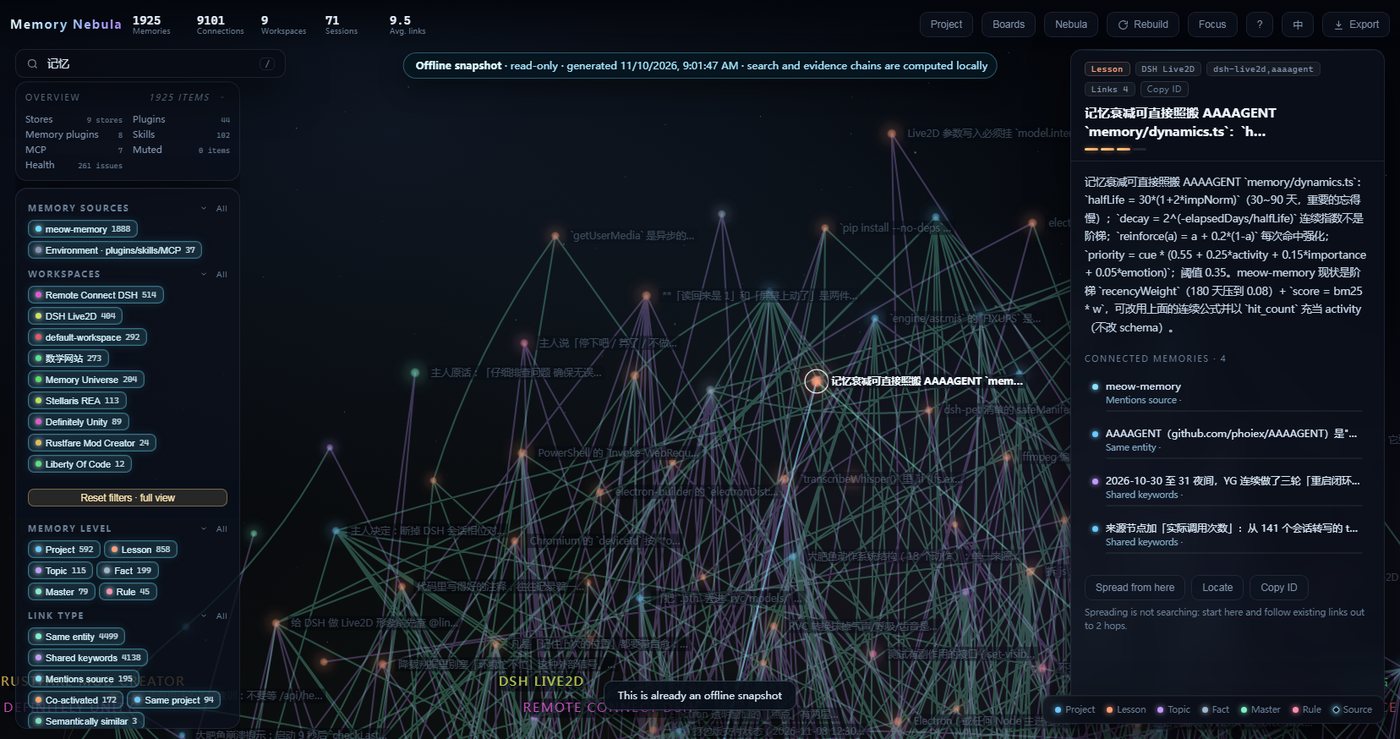
A whole graph or one slice becomes a self-contained HTML file. Open it on a plane, send it to a client; it still searches and draws evidence locally.
Every store opens read-only. Writes stay in $DSH_HOME/memory-nebula. The only way text leaves is the export you ask for.
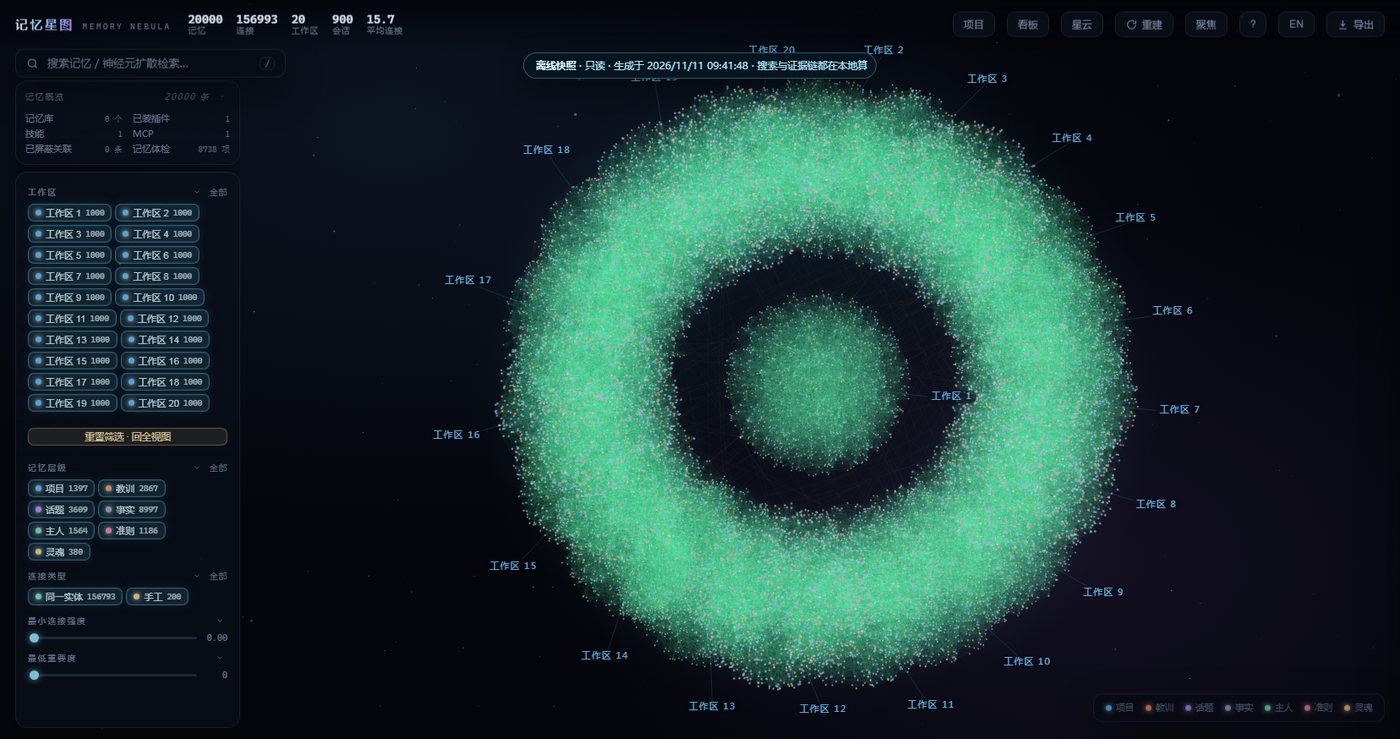
Entity pairing gets a budget above 12k nodes, candidate scoring stops allocating strings. Ten thousand stays at 1.2s; twenty thousand fits in a 3s build and 248MB heap.
Nine read-only checks: Node version, package files, profile wiring, bundled version, sources, endpoint, and version drift. If a blank page is a restart problem, it says so.
--share, --export, --scope, --token, --diagnose. Build a snapshot in CI, gate a release on 126 tests, or diagnose a customer without touching their memory text.
Tab into the map and arrow keys walk between stars by spatial direction; [ ] follow edges, + - zoom, 0 returns to the full map and Home jumps to the busiest star. Every move is announced through aria-live, and a plain-text index lists all N memories for screen readers — the canvases stay out of the accessibility tree instead of pretending to be images.
Captured from the live catalog: the English interface, the demo galaxy, and the 20k offline snapshot.
Install from the curated catalog, open the page inside DSH, and run the doctor only if something looks empty. No build step, no database migration, no account.
dsh plugin --profile web add dsh-memory-nebulanpm install dsh-memory-nebula@latestJust looking? npx -y -p dsh-memory-nebula memory-nebula --demo starts the built-in demo on 127.0.0.1:7891.
This is a viewer, not a sync service. The limits are part of the design, not a roadmap promise.